Is an MBA Still Worth It? What Working Professionals Need to Know
January 24th, 2026
Business CareersCareer Advice

For many professionals in the UK, the question is no longer whether an MBA is respected; it is whether an MBA is respected. It is whether it is worth doing now, under modern working conditions, and whether the return justifies the time, cost and effort involved.
The MBA has not lost relevance. What has changed is how value is created. Employers are less interested in where someone studied and more interested in what they can do: how they assess risk, interpret commercial information, lead people, and make decisions when the situation is unclear.
This guide is written for professionals who want a grounded, realistic view of the MBA, free of marketing gloss, academic posturing, and outdated assumptions about how careers actually progress in the UK.
What an MBA Is Meant to Solve (and Why It Sometimes Fails)
At its best, a Master of Business Administration develops judgement.
Not theory for its own sake, but the ability to balance competing priorities, read financial and operational signals, and make decisions that affect people, budgets and long-term outcomes. This is why MBAs have historically been associated with senior management and leadership roles.
Research published by the Graduate Management Admission Council (GMAC) shows that employers continue to associate MBA qualifications with strategic thinking and leadership readiness rather than narrow technical skills, particularly for professionals moving into senior responsibility.
The problem is that many MBA programmes still assume conditions that no longer reflect professional reality: unlimited study time, minimal external pressure, and tolerance for abstract academic models. For UK professionals already operating at the management level, that disconnect matters.
An MBA only works when it helps you think and act more effectively in real situations—not when it merely adds theoretical vocabulary.
For a practical overview of scope and content, this explanation of what an MBA is and how it works in practice provides useful context.
How UK Employers Actually Interpret an MBA Today
In the UK labour market, an MBA is neither a shortcut nor a guarantee. It is a multiplier effective only when applied to existing experience.
Data published by the Office for National Statistics (ONS) consistently places managers, directors and senior officials among the highest earners in the UK workforce. However, progression into these roles increasingly depends on leadership judgement, commercial awareness and financial literacy rather than tenure or technical excellence alone.
This aligns with findings from the Chartered Institute of Personnel and Development (CIPD), which has repeatedly highlighted gaps in leadership capability, strategic decision-making and commercial thinking across UK organisations.
In short, an MBA still carries weight—but only when it reflects how business is actually done.
Why Delivery Format Now Matters More Than Institutional Prestige
The traditional MBA model assumes that learners can step away from work, relocate, and study full-time. For most UK professionals, that assumption no longer holds.
Candidate research from GMAC shows a sustained shift towards online and blended MBA formats, driven primarily by flexibility and reduced opportunity cost rather than academic compromise.
A detailed comparison of online MBAs versus traditional MBA formats shows how these differences play out in practice for working professionals.
The Real ROI of an MBA: Beyond Salary
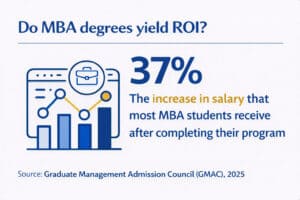
Salary uplift is often the headline metric used to justify an MBA. In reality, for many UK professionals, the most meaningful returns come well before a payslip changes and often persist long after.
The true value of an MBA lies in how it changes scope, credibility and decision authority, particularly in roles where outcomes depend on judgment rather than execution alone.
ROI That Shows Up in Responsibility, Not Just Pay
One of the most overlooked returns on an MBA is the opportunity to take on expanded responsibility.
Professionals who complete an MBA often report earlier involvement in:
strategic planning and forecasting
cross-functional decision-making
financial discussions beyond their immediate role
senior stakeholder or board-level conversations
These shifts are not always accompanied by an immediate salary jump, but they materially affect career trajectory. Increased exposure to strategic work tends to compound over time, creating opportunities that would otherwise remain inaccessible.
In UK organisations, where promotion cycles can be incremental and risk-averse, this form of ROI is often more durable than short-term salary gains. An MBA that strengthens commercial judgement and leadership reasoning allows professionals to be trusted with a broader remit, which, in practice, precedes formal advancement.
Why Flexible, Applied MBAs Deliver Stronger Long-Term Value
Modern careers rarely follow linear paths. Professionals move laterally, take on hybrid responsibilities, manage distributed teams, or balance leadership roles with personal commitments. In this context, how an MBA is delivered increasingly matters as much as what is taught.
Flexible, applied MBA programmes tend to produce stronger long-term ROI because they allow learning to be:
applied immediately in real work settings
tested against live organisational challenges
integrated alongside evolving responsibility
Rather than stepping away from work to study, professionals continue building experience while sharpening their decision-making framework. This combination — experience plus structured business thinking — is what employers ultimately reward.
A Short Decision Guide: Is an MBA the Right Next Step for You?
An MBA is likely to be a good fit if:
- You already make decisions that affect people, budgets or outcomes
- You are expected to think commercially, but have had no formal training
- You want broader strategic visibility rather than deeper technical specialism
- You need a qualification that can be completed alongside full-time work
You may want to pause or reconsider if:
- You are early in your career with limited organisational exposure
- You are primarily seeking academic prestige rather than applied capability
- You expect the qualification alone to drive promotion
Where Many UK Professionals Reach a Decision Point
At a certain stage, many professionals reach the same impasse. They see the value of an MBA, but not in its conventional form. They want structure and credibility, but not at the cost of stepping away from their career.
This is where more applied, flexible models come into focus.
The Master of Business Administration offered by the International Career Institute (ICI) is designed for professionals who want to formalise and strengthen their business capability while continuing to work. The programme is delivered fully online and structured around practical management disciplines rather than academic theory for its own sake.
You can explore the ICI MBA programme structure and entry requirements to assess whether it fits your experience and working commitments. Strengthen strategic capability without interrupting their career progression.
Online, career focused education that suits your lifestyle.
See our coursesElizabeth Hartwell is a content developer at the International Career Institute. Her interests include comparative education systems, lifelong learning, and the role of technology in expanding access to skills and credentials worldwide. She is particularly drawn to the relationship between education, policy, and workforce mobility. Outside of writing, Elizabeth enjoys contemporary non-fiction, cultural history, and travel, with a particular interest in museums and architecture.